888 206 4377
 Email
888 206 4377
Email
Email
888 206 4377
Email
The TWA shows a worker's daily exposure to occupational noise (normalized to an 8 hour day), taking into account the average levels of noise and the time spent in each area. This is the parameter that is used by the OSHA Regulations and is essential in assessing a workers exposure and what action should be taken.
Before working out the worker's TWA you have to measure the different high noise levels that the worker is subjected throughout a normal working day. The Time Weighted Average is calculated using these noise levels together with the amount of time that the worker is exposed to them.
First calculate the Noise Dose as:
Dose = 100 x (C1/T1 + C2/T2 + C3/T3 + ... + Cn/Tn)
where
Cn = time spent at each noise level
Tn = 8 / 2(L-90)/5 (L is the measured sound level)
It is often easier to get Tn from a lookup table:
A worker is exposed to 86 dB for six hours and 92 dB for a three hours, giving a nine hour working day.
Dose = 100 x (6/13.9 + 3/6.1) = 92.3%
| L | T | L | T | L | T | L | T | |
|---|---|---|---|---|---|---|---|---|
| 80 | 32.0 | 90 | 8.0 | 100 | 2.0 | 110 | 0.50 | |
| 81 | 27.9 | 91 | 7.0 | 101 | 1.7 | 111 | 0.44 | |
| 82 | 24.3 | 92 | 6.1 | 102 | 1.5 | 112 | 0.38 | |
| 83 | 21.1 | 93 | 5.3 | 103 | 1.3 | 113 | 0.33 | |
| 84 | 18.4 | 94 | 4.6 | 104 | 1.1 | 114 | 0.29 | |
| 85 | 16.0 | 95 | 4.0 | 105 | 1.0 | 115 | 0.25 | |
| 86 | 13.9 | 96 | 3.5 | 106 | 0.87 | 116 | 0.22 | |
| 87 | 12.1 | 97 | 3.0 | 107 | 0.76 | 117 | 0.19 | |
| 88 | 10.6 | 98 | 2.6 | 108 | 0.66 | 118 | 0.16 | |
| 89 | 9.2 | 99 | 2.3 | 109 | 0.57 | 119 | 0.14 |
Once you have the Dose% figure, you can calculate the TWA using the following equation:
TWA = 16.61 Log10 (D/100) + 90
where
TWA is the 8-hour Time Weighted Average Sound Level
D is the Dose % as calculated above (or measured with a dosimeter)
Log10 is the Logarithm to base 10
From our example above
TWA = 16.61 x Log10 (92.3 / 100) + 90
TWA = 89.4 dB
The OSHA action levels are based on either TWA or Dose % (which are different representations of the same number). These action levels are 85 dB (or 50% Dose) and 90 dB (or 100% Dose).
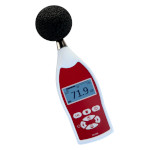
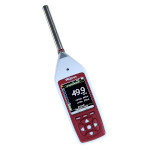
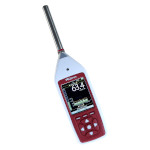
For workers who are moving between many different noisy locations it is usually easier to use a Noise Dosimeter. This device is attached to the worker at the start of the day and left to monitor the actual noise exposure. The dosimeter will usually provide you with the TWA and the Dose %, so there is no need to make any calculations.
 Cart
Cart